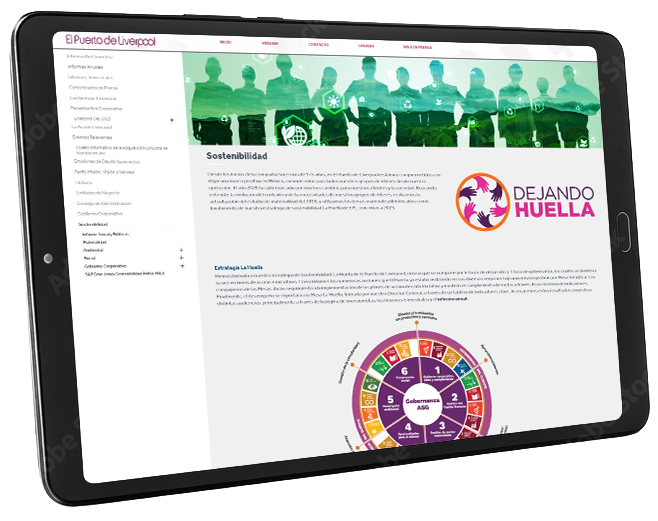

The Footprint of El Puerto de Liverpool is the strategy that guides the Company’s environmental, social, and governance management, integrating sustainability into decision-making and business operations. Based on the materiality analysis conducted in 2020 and updated in 2024, the strategy defines the priorities that guide the organization’s actions, considering its impact on the economy, the environment, and people, as well as the risks and opportunities that influence its performance and value creation.
The initiatives that comprise ‘The Footprint’ align with the UN 2030 Agenda and the corporate objectives established for 2030 and 2040, which serve as benchmarks for continuous progress and strengthening ESG management in a gradual and consistent manner. The periodic monitoring and reporting of these advancements, in alignment with international standards and indices such as the Dow Jones Sustainability Index, S&P/BMV Total ESG, Task Force on Climate-related Financial Disclosures, Sustainability Accounting Standards Board, and Global Reporting Initiative, reinforce the Company’s commitment to transparency, strategic coherence, and continuous improvement.
ESG Culture and External Assurance
At El Puerto de Liverpool, we promote an ESG (Environmental, Social, and Governance) culture across the organization and throughout our value chain. This culture is reflected in the integration of ESG criteria into internal processes, management and control mechanisms, and the clear and transparent communication of the impacts associated with our operations.
To strengthen the reliability of the reported information, the Sustainability Report undergoes an independent external verification process under a limited assurance scope, designed to evaluate whether the information is reasonably free of material errors, whether due to fraud or mistake. As a result, an independent third-party opinion report is issued.
Group Management is responsible for preparing the sustainability indicators and for the design, implementation, and maintenance of the internal controls necessary to ensure the consistency and reliability of the reported information.